Introduction
Search Engine Optimization (SEO) is the backbone of digital marketing and plays a crucial role in improving a website’s visibility on search engines like Google. It involves optimizing different elements of a website so that it can rank higher in search engine results pages (SERPs) and attract more organic traffic, including understanding the difference between on page and off page seo.
In SEO, two major components are widely used: On Page SEO and Off Page SEO. Both are essential for improving rankings, but they work in completely different ways. On Page SEO focuses on optimizing elements within your website, while Off Page SEO focuses on activities performed outside your website to build authority and trust.
Understanding the difference between On Page and Off Page SEO is important because it helps website owners and marketers create a balanced strategy that improves rankings, traffic, and overall online presence.
What is SEO?
Definition of SEO
SEO (Search Engine Optimization) is the process of optimizing a website to improve its visibility on search engines like Google, Bing, and Yahoo. The main goal is to increase organic (unpaid) traffic by making the website more relevant and trustworthy.
In simple terms, SEO helps your website appear in front of users when they search for related keywords.
Types of SEO
SEO is mainly divided into three types:
- On Page SEO – Optimization within the website
- Off Page SEO – Optimization outside the website
- Technical SEO – Improving website infrastructure like speed, indexing, and mobile usability
Among these, On Page and Off Page SEO are the most important for ranking improvement.
What is On Page SEO?
Definition of On Page SEO
On Page SEO is the practice of making improvements directly on a website to help it rank better in search engine results and provide a better experience for users. It ensures that both search engines and users can easily understand the content of a webpage.
Key Elements of On Page SEO
On Page SEO includes several important factors:
- Title Tags and Meta Descriptions
These help search engines understand the page topic and improve click-through rates. - Headings (H1, H2, H3 Structure)
Proper heading structure improves content readability and SEO organization. - URL Structure
Short, clean, and keyword-rich URLs are easier for search engines to crawl. - Keyword Optimization
Using relevant keywords naturally throughout the content improves ranking potential. - Internal Linking
Linking to other pages within your website improves navigation and spreads link authority. - Image Optimization
Using alt text and compressing images improves accessibility and page speed. - Content Quality and Readability
High-quality, original, and informative content is the most important ranking factor.
Importance of On Page SEO
On Page SEO is essential because it:
- Helps search engines understand your content clearly
- Improves user experience and website usability
- Increases chances of ranking higher on SERPs
- Gives full control over optimization strategies
Without proper On Page SEO, even good content may fail to rank effectively.
What is Off Page SEO?
Definition of Off Page SEO
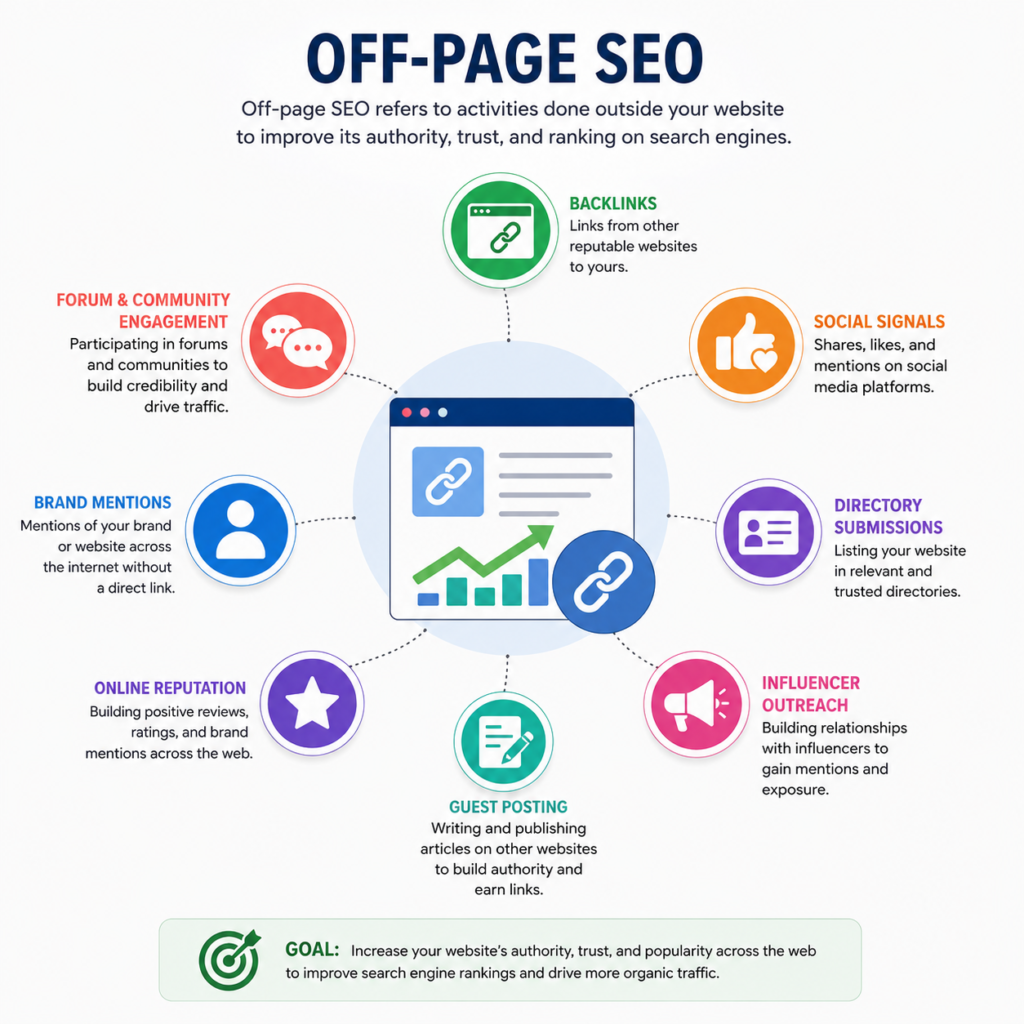
Off Page SEO refers to all the activities performed outside your website to improve its authority, credibility, and ranking in search engines. It focuses on building trust and reputation across the internet.
Key Elements of Off Page SEO
Off Page SEO mainly includes:
- Backlink Building
Getting links from high-authority websites improves trust and ranking. - Social Media Marketing
Sharing content on platforms increases visibility and engagement. - Guest Posting
Writing for other websites helps earn backlinks and exposure. - Influencer Outreach
Collaborating with influencers boosts brand awareness. - Brand Mentions and Citations
Even without links, mentions of your brand improve authority signals.
Importance of Off Page SEO
Off Page SEO is important because it:
- Builds domain authority and trust
- Enhances website credibility in the eyes of search engines
- Increases organic traffic from multiple sources
- Strengthens overall SEO performance
It acts as a reputation-building strategy for your website.
Key Difference Between On Page and Off Page SEO
Comparison Based on Key Factors
The main difference between On Page and Off Page SEO include:
- Location of Optimization:
On Page SEO is done within the website, while Off Page SEO is done outside the website. - Control:
On Page SEO is fully controlled by the website owner, whereas Off Page SEO depends on external sources. - Focus Area:
On Page SEO focuses on content and structure, while Off Page SEO focuses on authority and trust-building. - Techniques Used:
On Page SEO uses keywords, meta tags, and internal links, while Off Page SEO uses backlinks, social sharing, and outreach. - Impact on Rankings:
On Page SEO improves relevance, while Off Page SEO improves credibility.
Simple Table Comparison
| Factor | On Page SEO | Off Page SEO |
| Location | Within website | Outside website |
| Control | Fully controlled | Partially controlled |
| Focus | Content & structure | Authority & trust |
| Main Technique | Keywords, meta tags | Backlinks, outreach |
| Goal | Improve relevance | Improve credibility |
How On Page and Off Page SEO Work Together?
Both On Page and Off Page SEO complement each other and deliver the strongest results when combined.
For example, if you create high-quality, optimized content (On Page SEO), it may still need backlinks (Off Page SEO) to rank higher on Google. Similarly, backlinks pointing to poorly optimized content will not bring strong results.
A successful SEO strategy combines both:
- Strong content + keyword optimization (On Page SEO)
- High-quality backlinks + brand authority (Off Page SEO)
Together, they improve rankings, traffic, and long-term visibility.
Common Mistakes to Avoid
Many websites fail in SEO due to common mistakes such as:
- Keyword stuffing, which makes content unnatural
- Building low-quality or spammy backlinks
- Ignoring mobile-friendly website design
- Publishing thin or duplicate content
- Not updating old content regularly
Avoiding these mistakes helps maintain strong SEO performance.
Conclusion
The difference between On Page and Off Page SEO lies in where and how optimization is done. On Page SEO focuses on improving elements within the website such as content, structure, and keywords, while Off Page SEO focuses on building authority through external efforts like backlinks and social signals.
Both are equally important for achieving higher search engine rankings. On Page SEO ensures your website is relevant and user-friendly, while Off Page SEO builds trust and authority.
A successful SEO strategy always includes a balance of both. When combined effectively, On Page and Off Page SEO can significantly improve your website’s visibility, organic traffic, and overall performance on search engines like Google.
